


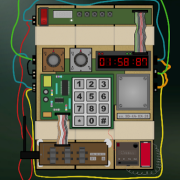

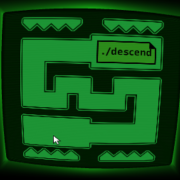









There Is No Game begins by insisting that there is nothing to play. A voice addresses the player directly, recommends leaving, and complains whenever the screen is touched. Ignoring those instructions reveals the real structure: nearly everything on the supposedly empty interface can become part of a puzzle. Letters, buttons, panels, screws, and even the narrator’s attempts to stop the player are objects that can be manipulated to uncover the next step.
Breaking the “Non-Game”
The first puzzle revolves around the words “There Is No Game.” Repeatedly clicking the letter O knocks it loose, and dropping it eventually reveals a volume button. Muting the voice causes increasingly elaborate attempts to protect that button, including wooden and metal barriers. Breaking through them scatters the title letters and exposes screws that can be removed, revealing a space where those letters can be rearranged into new words.
Turning Letters Into Puzzles
Spelling GAME opens a brick-breaking minigame, although the narrator actively interferes by destroying the ball. Another ball can be recovered and used to finish the stage, after which a trophy becomes available. The same loose letters can also spell TREE and GOAT, opening additional puzzle areas that are connected rather than functioning as separate levels.
The main sequence involves:
· knocking objects loose from the title screen;
· muting the narrator and breaking his defenses;
· rearranging letters to create GAME, TREE, and GOAT;
· completing the brick-breaking section;
· using the trophy to transport water;
· growing a tree and retrieving a key;
· freeing the caged goat.
The goat cannot simply be released after it appears. Its key is taken by a flying squirrel, so the player must repeatedly fill the trophy from a waterfall and use it to grow the tree. A nut can then be knocked down, cracked with the earlier metal box, and given to the squirrel in exchange for the key. As the player finally frees the goat, glitches begin overtaking the screen and the narrator admits that the situation has gone wrong.
One Last Choice
The ending depends on a final yes-or-no response when the narrator asks for forgiveness. Forgiving him produces one conclusion, while refusing leads to a shorter, more hostile response. There Is No Game therefore uses only a small collection of screens and objects, but constantly changes what those objects mean. Progress comes from disobeying instructions, experimenting with the interface, remembering earlier items, and treating the “game” itself as the puzzle rather than controlling a conventional character.
