
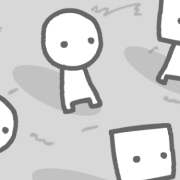













We Become What We Behold gives the player a camera and a small crowd of circle-headed and square-headed people. Instead of directly controlling the characters, the player chooses what to photograph. Each selected moment is displayed on a large television screen, where everyone in the crowd can see it. What appears on that screen influences how people behave afterward, turning photography into the central mechanic of a short simulation about attention, fear, and conflict.
Choosing What Becomes News
At first, the crowd is mostly peaceful. Characters wander around, interact, and occasionally behave in ways that might attract attention. Photographing an unusual or confrontational moment causes it to become the focus of the broadcast. Peaceful interactions, however, do not create the same reaction. This gradually encourages the player to search for more dramatic scenes because conflict is what produces noticeable changes in the crowd.
A Cycle That Keeps Growing
The important part is not simply taking pictures, but watching how one photograph changes what can happen next. Showing an angry Circle confronting a Square makes other Squares increasingly suspicious of Circles, which then creates more hostile encounters to photograph. The game deliberately creates a one-way feedback loop in which sensational images generate new conflict, and that conflict provides even more sensational material.
During the game, the player can:
· move the camera frame across the crowd;
· photograph specific characters or interactions;
· watch selected images appear on the central screen;
· observe how viewers react to what has been shown;
· capture increasingly aggressive encounters;
· influence the behavior of the entire crowd through repeated coverage.
The escalation eventually becomes difficult to stop. Hatred spreads between the two groups, characters begin openly attacking one another, and the atmosphere changes from harmless curiosity to widespread violence. The player does not fight anyone directly; the consequences emerge from which moments are repeatedly selected for attention. The final violent outbreak demonstrates where the feedback loop has led.
After the Crowd Turns
We Become What We Behold ends on a darker note, but it does not leave every character trapped in the same cycle. After the main ending, a Circle and a Square remain together, providing a small counterpoint to the hostility that consumed the rest of the crowd. The entire experience revolves around one repeated action—choosing what deserves to be seen—but each photograph changes the social environment, making observation and selection the only tools the player needs to push the story toward its conclusion.
